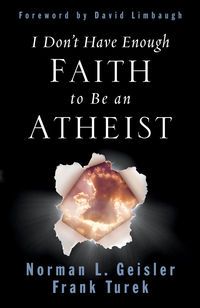
What? You need faith to be an atheist? Well, when a lot of people think about faith, they think about blind faith. Believing something just because. Is that what our religion is to us?
Norman L. Geisler and Frank Turek, the authors of I Don't Have Enough Faith to Be an Atheist, point out that many atheists go through the same thought processes as many Christians. In fact, they say, scientists who claim to be objectively observing the facts can become agitated when evidence seems to contradict what they believe to be true, just like people whose religious convictions are challenged. Atheism itself can become like a religion for some people, with its own strong set of beliefs and opinions. Can we know who is right and who is wrong? Can we draw an objective conclusion from the evidence we have in this world?
"So," my son asked, "if we descended from apes, and we still have apes, and we still have humans, why didn't the in-between species survive?" He is thinking right along the lines the authors want him to think. In fact, they point out, not only didn't they survive, but between-species creatures could not survive. If birds with feathers evolved from reptiles with scales, as Darwin asserted, then there would have been some sort of in-between species that no longer had scales but didn't quite have feathers. That creature could not have survived, so no bird would have evolved. Scientifically, this is impossible.
I Don't Have Enough Faith to Be an Atheist draws on a little bit of Intelligent Design (one of my favorite topics in the world), historical documentation, scientific evidence, and lots and lots of logic to show that there is plenty of evidence that proves the truth of Christianity. We do not have to believe in God based on "blind faith," and in fact, it requires some "blind faith" to believe otherwise. As James Tour, a Nanoscientist, is quoted saying at the beginning of one of the chapters: "Only a rookie who knows nothing about science would say science takes away from faith. If you really study science, it will bring you closer to God."
Now faith is the substance of things hoped for, the evidence of things not seen. Hebrews 11:1 KJV
 I have taught Intelligent Design, historical documentation for Christianity, and logic to my kids in homeschool, and am always looking for curriculums that support these themes and our Christian worldview, so I was thrilled to see that Apologia (simply one of our favorite companies for both science and Bible curriculums) has developed a workbook to go along with this fabulous book and turn it into a whole curriculum. At first, I planned to use this with my children all together, but I realized it was going to be over the heads of all but my oldest. He's beginning 9th grade this year, and this book is right up his alley. He's right at the stage on the classical education spectrum where he should be reading and understanding this kind of logic, and he is. He has a very logical, practical mind like his dad, and I am glad to have books like this to use with him, because I believe it will stay with him for life. I am working through this entire book and workbook with him, and I believe I am learning as much as I am teaching!
Apologia's workbook for I Don't Have Enough Faith to Be an Atheist is really much more than a workbook. When I think of a workbook for a study like this, I expect it to basically have discussion and review questions to go along with the text. Apologia's workbook, however, develops the ideas in the book and turns the textbook into a complete curriculum. It reviews each chapter of the text, provides additional information for diving deeper into the issues, gives assignments and ideas for research and projects so that the student can learn more on his own, and discusses application of what he has learned. I loved the extra information given on key figures on both sides of the Christianity/Atheism debate, such as Carl Sagan, C.S. Lewis, and Richard Dawkins. (My son's favorites are C.S. Lewis and J.R.R. Tolkien!) There is also biographical information on historical characters such as Hitler and Josephus. Logic charts, historical information, information on other religions and worldviews, and some photographs of things like the caves where the Dead Sea Scrolls were found and ancient art all work together to make this what I would consider to be an effective "capstone" high school course. A "capstone" course is one that brings together all the other courses you've studied and helps you apply them to your life. After you've studied all this history, art, science, literature, and religion, what do you believe? What is your worldview? How does it affect how you live? I am using this as a "capstone" course over what we have studied up to this beginning-high-school point, and to be effective, I may repeat it (or parts of it) during my son's senior year. I may also use this as a Bible study or small group for teens or adults.
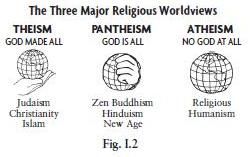
Many of us grew up in Christian households with parents who were brought up in Christian households in communities where most people went to some kind of church and had some minor denominational differences. Not so with our children. They are already being exposed to a multitude of worldviews, religions, and a plethora of scientific evidence. This is not a bad thing. People whose ideas have been tested know more firmly what they believe and why. We do, however, need to give our children the tools with which to evaluate the overload of ideas that are being thrown at them. Using a course like Apologia's that teaches them how to think rather than just what to think will help them navigate these intellectual waters throughout high school, college, and their lifetimes. Apologia has several worldview books to this end, and I believe this workbook used in conjunction with the text of I Don't Have Enough Faith to Be an Atheist is one of the best I have seen.
The Product: I Don't Have Enough Faith to Be an Atheist Curriculum workbook by Frank Turek and Chuck Winter and
I Don't Have Enough Faith to Be an Atheist book by Norman L. Geisler and Frank Turek
Vendor: Apologia Educational Ministries
Website http://www.apologia.com
Ages: High School thru Adult
Price: $16 for the book I Don't Have Enough Faith to Be an Atheist
$33 for the I Don't Have Enough Faith to Be an Atheist Curriculum workbook
I'm going to say you probably just need to go right now and order this curriculum, but if you'd like to see what my Schoolhouse Crewmates have to say, click the banner below!